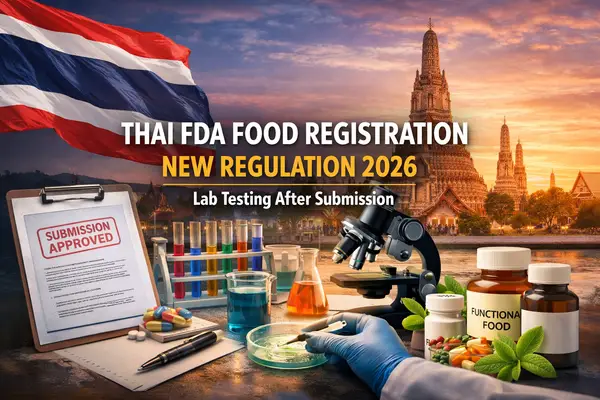
Thai FDA Food Registration New Regulation 2026: What Changes for Functional Food and Nutraceuticals
The Thai FDA has introduced a major update to the food registration process, published in the Royal Gazette on March 9, 2026.
The new regulation changes the traditional approach by separating document evaluation from laboratory testing, significantly impacting how functional food and nutraceuticals are registered in Thailand.
Thai FDA Food Registration New Regulation 2026: Lab Testing After Submission
Under the Thai FDA food registration new regulation 2026, laboratory testing is no longer required before submission.
Instead:
- applications can be submitted without prior lab analysis
- testing may be requested by the FDA during or after the review process
- authorities maintain the right to verify product compliance post-approval
This represents a fundamental shift in regulatory strategy.
Impact on Functional Food and Nutraceuticals Registration in Thailand
For companies entering the Thai market with functional food and nutraceuticals, the new regulation creates both opportunities and risks.
Faster market entry
- reduced pre-submission requirements
- shorter preparation timelines
Increased regulatory exposure
- potential post-approval testing
- risk of product suspension or recall
- higher importance of dossier accuracy
Stronger Focus on Product Consistency and SKU Management
The Thai FDA food registration new regulation 2026 places significant emphasis on:
- consistency between submitted products and approved licenses in other countries
- clear and structured SKU lists
- alignment between product families and technical documentation
Discrepancies between markets (e.g. Indonesia vs Thailand) may trigger additional scrutiny or revision requests.
New Requirements on Labeling and Traceability
The regulation introduces stronger expectations on:
- traceability systems (QR code, Data Matrix, sequence numbers)
- labeling clarity (importer, distributor, origin)
- digital information accessibility
These elements reflect a broader shift toward post-market surveillance and control.
Regulatory Strategy Shift: From Pre-Control to Post-Control
The new food registration regulation marks a clear transition:
- from pre-approval validation
- to post-market enforcement
This means that compliance responsibility is increasingly transferred to the manufacturer and license holder.
Why Pre-Assessment Becomes More Important Than Ever
Although laboratory testing is no longer mandatory before submission, conducting a voluntary pre-assessment remains critical.
For functional food and nutraceuticals, this includes:
- internal lab testing
- dossier verification
- ingredient and claims validation
This approach reduces the risk of regulatory actions after approval.
Conclusion: A More Flexible but Risk-Oriented System
The Thai FDA new regulation 2026 in Food sector introduces a more flexible system for market entry, but also a higher level of regulatory responsibility.
Companies entering Thailand with functional food and nutraceuticals should adapt their strategy accordingly, focusing on proactive compliance rather than minimum submission requirements.