New Thailand Food Advertising Law 2026: What It Means for Distributors
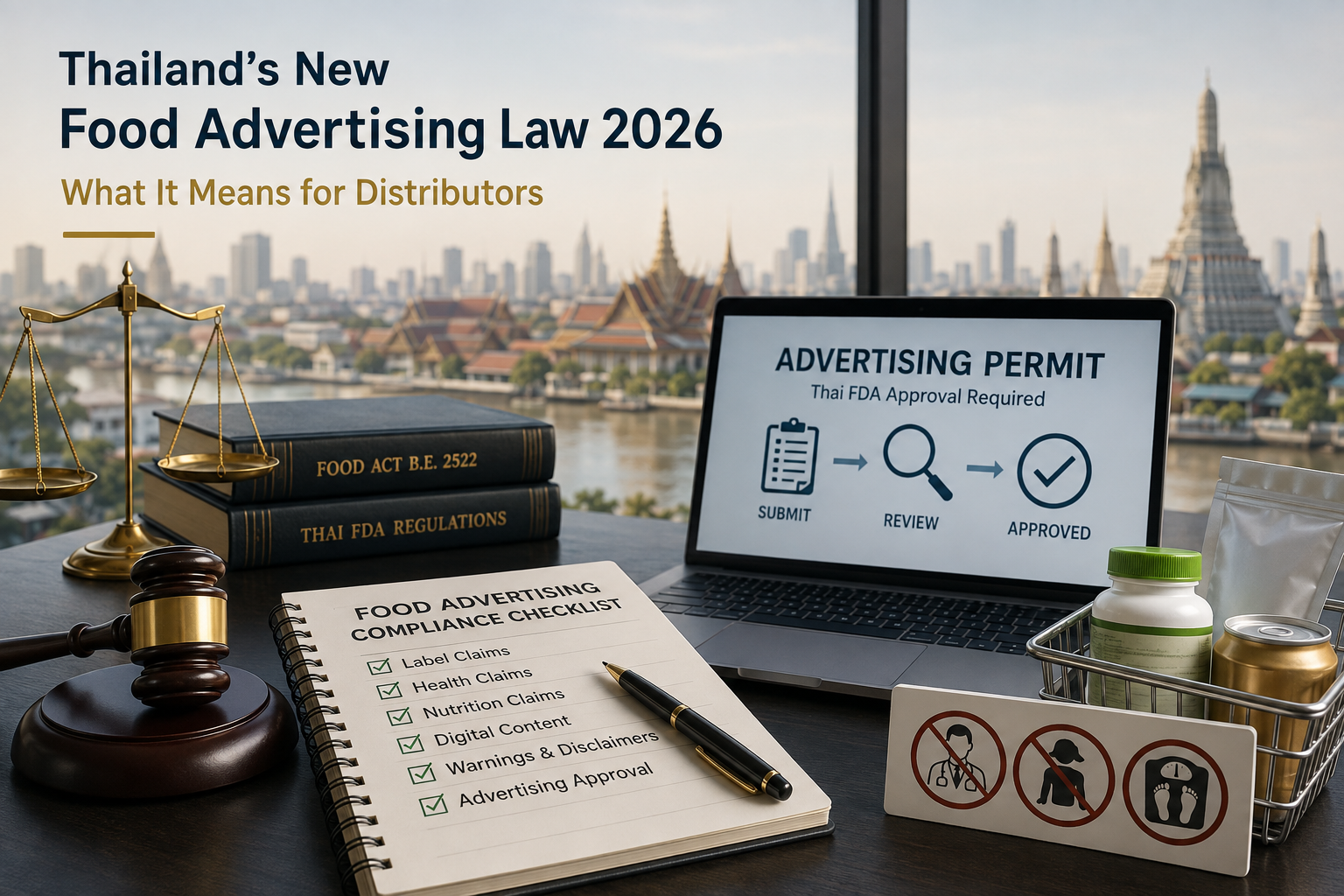
On July 13, 2026, Thailand’s FDA published the new Notification Re: Criteria for Food Advertising B.E. 2569 (2026) in the Royal Gazette, effective from July 28, 2026. It fully replaces the 2021 rules and reshapes how anyone selling, importing, or distributing food products in Thailand can advertise them. For companies in the sector, understanding Thailand food advertising law is no longer a legal footnote — it’s an operational requirement that directly affects labeling, ads, packaging, and content marketing.
What the new Thailand food advertising law covers
Based on Sections 40, 41, and 42 of the Food Act B.E. 2522, the Thailand food advertising law introduces much more detailed criteria than before:
- Prohibited messages (Clause 4): content that creates false expectations about ingredients, causes confusion about the product, undermines social harmony, is contrary to good morals, encourages dangerous imitative behavior, uses medical/health personnel to endorse a food, or disparages competitors.
- False or misleading claims (Clause 5): no promises of curing or preventing disease, no claims about changing body structure, no references to sexual performance, beauty, or weight loss/fat-burning, except for specific pre-approved exceptions.
- Advertising exempt from prior approval (Clause 6 + Annex 2): neutral academic information, corporate image ads, and a detailed list of “safe” claims (e.g. “natural,” “organic,” “gluten-free,” “award received,” “new packaging”) provided they’re backed by documentation and used under the stated conditions.
- Advertising requiring prior approval (Clause 7 + Annex 3): nutrition claims, health claims, and anything going beyond what’s already approved on the label must be submitted to the Thai FDA before publication.
- Special rules for sensitive categories (Clause 10): infant food (advertising banned outright), milk-based drinks, dietary supplements, caffeinated beverages, kratom products, hemp/CBD — with strict requirements on model age, mandatory warnings, and claim limits.
- Mandatory warnings (Clause 9.2 + Annex 4): minimum text size, minimum on-screen display duration, and specific wording required for categories like supplements, sweeteners, chia seed, kratom, and hemp/CBD.
Implications for distributors
- Review packaging, ads, and social content. Every claim currently used — including on Facebook, Instagram, or TikTok, which fall under the law’s definition of “food advertising” — needs to be checked against Annexes 2 and 3 to see if prior approval is required.
- Longer approval timelines. Advertising under Clause 7 must be submitted to and approved by the Thai FDA before it runs, which extends campaign and product-launch timelines.
- Documentation backing claims. Many “free” claims still require supporting evidence (analysis reports, GMP/HACCP certifications, formula compliance statements) that must be kept ready for inspection.
- High-risk categories. Distributors of supplements, energy drinks, caffeinated beverages, kratom, or hemp/CBD products need to carefully review model-age and warning requirements — non-compliance risks revocation of the advertising permit.
- Five-year permit validity. Approved advertising permits are valid for a maximum of 5 years, so renewals need to be planned ahead to avoid campaign interruptions.
- Transition period. Ads already approved before July 28, 2026 remain valid until their permit expires — no need to redo everything overnight — but any new claims must already follow the new rules.
Pros and cons of the Thailand food advertising law
Pros
- Greater operational clarity: Annexes 2 and 3 provide detailed lists of allowed and prohibited claims, reducing the interpretive ambiguity of the previous rules.
- Consumer protection and industry reputation: cracking down on false or exaggerated health claims also protects legitimate operators from unfair competition based on untrue promises.
- Better alignment with digital channels: the broad definition of “advertising message” explicitly covers social and digital content, closing a gap in the 2021 regulation.
- Streamlined exemptions for low-risk claims (price, point of sale, certification marks), which don’t require prior approval.
Cons
- Heavier compliance burden for claims requiring prior approval, with possible bottlenecks in campaign launch timelines.
- Very tight restrictions on growing categories like kratom or CBD supplements, sharply limiting messaging freedom in markets with strong demand.
- Need for local legal expertise: the complexity of the annexes (especially 2 and 3, with dozens of items and conditions) makes local regulatory counsel almost essential to avoid violations.
- Risk of inconsistent enforcement: as with many Thai FDA regulations, practical interpretation by licensing officers can vary, creating uncertainty during the initial rollout.
What to do now if you distribute food in Thailand
- Audit all claims currently used on labels, ads, and digital channels.
- Check which claims fall under the “exempt” list (Annex 2) vs. which require approval (Annex 3).
- Gather or update supporting documentation (approved formulas, nutrition analysis reports, production certifications).
- Plan advertising-approval submissions early, factoring in Thai FDA processing times.
- Track expiration dates on existing advertising permits.
This article is for informational purposes and does not replace legal advice. For a specific review of your advertising claims under Thailand’s new food advertising law, contact the Siam Development team.