
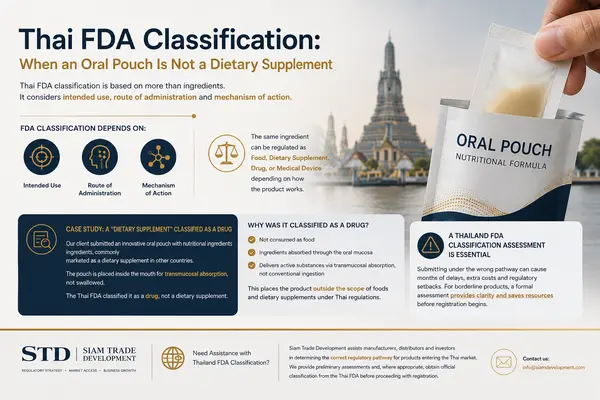
Thai FDA Classification: When an Oral Pouch Is Not a Dietary Supplement
One of the most common misconceptions among foreign manufacturers is that product classification under the Thailand FDA depends primarily on the ingredients.
FDA Classification Depends on More Than Ingredients
In reality, Thai FDA classification is based on several regulatory factors, including the product’s intended use, route of administration and mechanism of action. The same ingredient may fall under different regulatory frameworks depending on how the product is designed and used.
A recent classification assessment conducted by Siam Trade Development illustrates this principle.
Case Study: A “Dietary Supplement” Classified as a Drug
Our client submitted an innovative oral pouch containing nutritional ingredients commonly marketed as dietary supplements in other jurisdictions.
The pouch was not intended to be swallowed. Instead, it was placed inside the mouth, allowing the ingredients to be absorbed through the oral mucosa before the pouch was discarded.
Based on its commercial positioning, the manufacturer considered the product to be a dietary supplement.
However, after reviewing the product, the Thai FDA classified it as a drug rather than a dietary supplement.
The decision was not driven by the ingredients themselves.
Instead, the authority focused on the route of administration.
Why Did the Thai FDA Classify the Product as a Drug?
The reviewer considered several regulatory aspects:
- the product is not consumed as food;
- the ingredients are intended to be absorbed through the oral mucosa;
- the product delivers its active substances through transmucosal absorption rather than conventional ingestion.
These characteristics place the product outside the scope normally applied to foods and dietary supplements under Thai regulations.
This case demonstrates that Thailand FDA classification is based on how the product works, not simply on what it contains.
The Same Ingredient Can Belong to Different Regulatory Categories
One of the key principles of Thai FDA classification is that the same ingredient may belong to different regulatory categories.
Depending on the product’s intended use and route of administration, the same substance may be regulated as:
- Food
- Dietary Supplement
- Drug
- Medical Device
For this reason, relying on the classification adopted in another country can be misleading.
Why a Thailand FDA Classification Assessment Is Essential
Submitting a product under the wrong regulatory pathway can result in months of unnecessary work, additional costs and significant delays.
For borderline products such as oral pouches, buccal delivery systems, innovative dosage forms and combination products, obtaining a Thailand FDA Classification Assessment before preparing the registration dossier is often the most efficient strategy.
A formal assessment provides regulatory certainty before substantial resources are invested in the registration process.
Need Assistance with Thailand FDA Classification?
Siam Trade Development assists manufacturers, distributors and investors in determining the correct regulatory pathway for products entering the Thai market.
If your product incorporates innovative dosage forms, novel delivery systems or borderline claims, we can perform a preliminary regulatory assessment and, where appropriate, obtain an official classification from the Thailand FDA before proceeding with registration.
