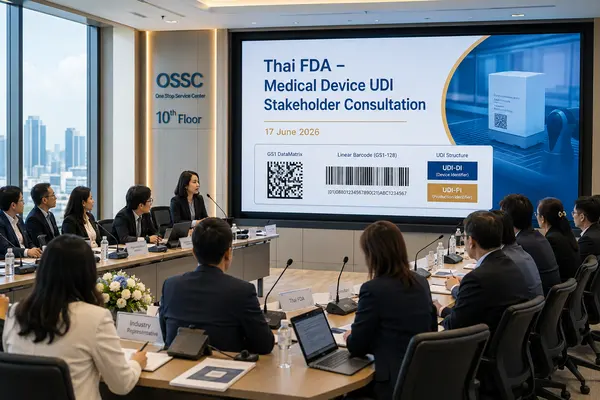
Medical Device UDI Thai FDA: What Really Happened at the June 17, 2026 Meeting
On June 17, 2026, in the 10th-floor meeting room of the OSSC building, the Thai FDA convened a decisive stakeholder consultation meeting on the future of medical device UDI Thai FDA: a session dedicated to preparing all stakeholders for the introduction of the Unique Device Identification (UDI) coding system for medical devices sold in Thailand.
The Day Medical Device UDI Thai FDA Became Reality
Siam Development was in the room, represented by our Senior Regulatory Manager Piyawan Arworn, alongside delegates from 130 other companies in the industry. In this article, we share what really emerged about medical device UDI Thai FDA: not just what you’ll read in the official press release, but also what was shared “between the lines” during the technical discussion with the Medical Device Control Division (MDCD).
Who Attended the Medical Device UDI Thai FDA Meeting
The official attendee list, published by the Thai FDA, counts 131 companies invited to discuss the implementation of medical device UDI Thai FDA. One detail stands out immediately when looking at the composition of the room: the vast majority of attendees were importers and distributors of medical devices, while the regulatory consulting firms present could be counted on one hand.
This seemingly minor detail actually says a lot about the state of the regulatory services market in Thailand around medical device UDI Thai FDA. If the UDI topic were already perceived as mature and “consulting-ready” — as is the case, for instance, in the EU or US markets, where regulatory affairs firms systematically sit at these tables — we would expect a much larger presence of specialized consultants. The picture coming out of the OSSC meeting room instead is one of a Thai regulatory consulting sector that is still not very structured around this specific topic, leaving companies themselves (often without dedicated regulatory support) to interpret the requirements on their own. In our view, this is a signal that industry operators — and consulting providers like us — should watch closely in the coming months.
Medical Device UDI Thai FDA: What the Official Announcement Really Says
For those who weren’t at the meeting, the main source of information remains the Ministry of Public Health Notification B.E. 2568 (2025), published in the Royal Gazette on December 22, 2025. The press release on medical device UDI Thai FDA is clear: as of June 20, 2026, the UDI system is officially in force in Thailand, replacing the previous 2020 labeling regulation.
In summary, here’s what the medical device UDI Thai FDA regulation requires:
- UDI is conditionally required for medical devices of risk class 2, 3 and 4.
- For the first time, a specific UDI requirement is introduced for Software as a Medical Device (SaMD), in risk categories 2, 3 and 4.
- The label and instructions for use (IFU) must include, where applicable, the UDI code alongside the lot/serial number.
- For SaMD, the IFU may be provided in electronic format (QR code, website).
- A 120-day transition period is provided for achieving full compliance.
That’s what anyone can read online about medical device UDI Thai FDA. But those sitting in the room on June 17 heard a more nuanced version of this story — and in some respects, a different one.
Medical Device UDI Thai FDA: The Reality According to Those in the Room
Yes, the UDI system is “official” as of June 20, 2026. But “official” doesn’t mean “100% operational.” During the meeting, officials from the Medical Device Control Division clarified a key point about medical device UDI that the press release doesn’t mention: at the moment, the system is not yet strictly enforced, because the entire submission infrastructure still needs to be adapted.
The mechanism described by the Thai FDA for medical device UDI works, conceptually, as follows:
- The UDI code must be generated by the manufacturer (the device’s producer), according to recognized standards (e.g. GS1, ICCBBA).
- The manufacturer transmits the UDI code to the registrant (the Thailand registration holder, typically the importer or local authorized representative).
- The registrant will then need to link the device’s technical documentation to the UDI code within the Thai FDA system.
Anyone working in the cosmetics sector will find this scheme familiar: it’s conceptually similar to the PIF (Product Information File) required for cosmetic products, where technical documentation is linked to a unique product identifier.
The key point, however, is this: the Thai FDA’s e-submission system has not yet been adapted to operationally manage this link between UDI and technical documentation. In other words, the medical device UDI FDA regulation exists and is in force, but the technical “plumbing” needed to make it work in practice is still under development.
What This Means in Practice for Companies: No Panic, But Get Ready
The takeaway message from the medical device UDI Thai FDA meeting is balanced, and we want to convey it with the same clarity with which it was communicated to us in the room:
- There is no immediate urgency to act. The submission system is not ready to receive and validate the UDI-documentation link, so there is currently no strict operational obligation to meet overnight.
- There is, however, urgency to prepare. Companies that sell or intend to sell class 2, 3 and 4 medical devices in Thailand — including SaMD software — should start now to:
- check whether their devices already have a valid UDI code (e.g. because they’re already registered in the EU, US, or other IMDRF-aligned markets);
map out the chain for transmitting UDI information from the manufacturer to the local registrant; - keep an eye on Thai FDA updates to the e-submission system, which will most likely be modified in the coming months to integrate this functionality.
- check whether their devices already have a valid UDI code (e.g. because they’re already registered in the EU, US, or other IMDRF-aligned markets);
For companies that already hold an UDI Thai FDA-compatible code assigned in other markets, the compliance path will be relatively straightforward: the main obligation will be submitting the master data to the Thai FDA’s UDI database, once the infrastructure is ready.
Why This Gap Between Regulation and System Is an Opportunity (Including for Regulatory Consulting)
Going back to the point raised at the start: the low turnout of regulatory consultants at the Thai FDA meeting isn’t just a curious statistic. In our view, it’s a signal of a market in transition — one where companies, especially importers and distributors without an in-house regulatory team, risk misreading the difference between “regulation in force” and “system operational,” with the risk of moving either too late (losing valuable time) or too early and in a disorganized way (investing resources into a submission the system isn’t yet able to accept).
Siam Development will continue to closely monitor developments on medical device UDI, actively participating in consultation meetings with the Thai FDA and updating our clients not only on what’s published in official announcements, but also on what genuinely emerges from direct engagement with the Medical Device Control Division.
Conclusion
Medical device UDI system is, for all intents and purposes, law as of June 20, 2026. But the regulation and the technical infrastructure that makes it operational don’t always move in lockstep — and that’s exactly the case in Thailand right now. The watchword for companies operating in the Thai medical device market is: be ready, don’t rush. Start preparing your devices’ UDI codes and the related documentation chain now, without scrambling over a submission process the Thai FDA’s system is not yet able to handle.
For support with UDI compliance in Thailand, or for any medical device registration needs in the Thai market, Siam Development’s regulatory team is here to help.