
Thailand FDA Medical Device Registration Timeline: What the Data Actually Shows
There is a question we hear in almost every first conversation with a new client. It comes in different forms — “How long will it take?”, “Can you give me a guarantee?”, “My previous consultant said three months” — but it always points to the same underlying concern: predictability.
We understand it. Launching a medical device in Thailand involves real business decisions — distribution agreements, inventory planning, investor timelines. Uncertainty is uncomfortable, and anyone who has worked with a less experienced consultant has probably been handed a confident estimate that later turned out to be fiction.
So instead of offering estimates, we offer something more useful: data.
Below are three real registration cases managed through the TFDA e-submission system, across three different device classes. The patterns they reveal are more instructive than any general timeline we could give you.
Three Real Cases — One Clear Pattern
| Device | Class | Total Duration | Revision Rounds | Expert Review |
|---|---|---|---|---|
| Contact lenses | Class 2 | ~7 months | 3 | No |
| Robotic surgical system | Class 3 | ~4.5 months | 4 | No |
| High-risk device (abridged) | Class 4 | ~50 days | 2 | No |
If your instinct is to look at this table and assume something has gone wrong — that the Class 4 device cannot possibly have cleared faster than the Class 2 — you are not alone. And that instinct is exactly the misconception this post is here to address.
Device class does not determine your timeline. Documentation quality does.
The contact lens registration — a product category that circulates in the industry as “fast and easy” — took seven months and required three separate rounds of revision. The Class 4 device, carrying the highest risk classification under Thai FDA, was approved in fifty calendar days with two revision rounds and no expert committee involvement.
The difference was not the regulator. It was the file.
What Happens Inside a TFDA Review
The table below shows the complete workflow for each case, as recorded by TFDA reviewing officers. Reading it carefully reveals something important: the timeline is not continuous. It moves in bursts, and it stops every time a revision is requested — restarting only when the applicant responds.
| Date | Device | Event |
|---|---|---|
| 30 Oct 2025 | Contact lenses (Class 2) | Application opens |
| 18 Feb 2026 | Contact lenses (Class 2) | Revision request — Round 1 |
| 2 Mar 2026 | Contact lenses (Class 2) | Applicant resubmits |
| 20 May 2026 | Contact lenses (Class 2) | Revision request — Round 2 |
| 20 May 2026 | Contact lenses (Class 2) | Applicant resubmits same day |
| 26 May 2026 | Contact lenses (Class 2) | Revision request — Round 3 |
| 26 May 2026 | Contact lenses (Class 2) | Applicant resubmits same day |
| 28 May 2026 | Contact lenses (Class 2) | Accepted — no expert review |
| 30 May 2026 | Contact lenses (Class 2) | Approved |
| 24 Nov 2025 | Robotic surgical system (Class 3) | Application opens |
| 15 Dec 2025 | Robotic surgical system (Class 3) | Revision request — Round 1 |
| 20 Dec 2025 | Robotic surgical system (Class 3) | Applicant resubmits |
| 18 Feb 2026 | Robotic surgical system (Class 3) | Revision request — Round 2 |
| 19 Feb 2026 | Robotic surgical system (Class 3) | Applicant resubmits next day |
| 20 Feb 2026 | Robotic surgical system (Class 3) | Revision request — Round 3 |
| 20 Feb 2026 | Robotic surgical system (Class 3) | Applicant resubmits same day |
| 26 Feb 2026 | Robotic surgical system (Class 3) | Accepted — no expert review |
| 4 Mar 2026 | Robotic surgical system (Class 3) | Returned for correction by senior officer |
| 6 Mar 2026 | Robotic surgical system (Class 3) | Revision request — Round 4 |
| 12 Mar 2026 | Robotic surgical system (Class 3) | Applicant resubmits |
| 1 Apr 2026 | Robotic surgical system (Class 3) | Resubmitted for senior approval |
| 7 Apr 2026 | Robotic surgical system (Class 3) | Approved |
| 21 Sep 2025 | High-risk device, abridged (Class 4) | Application opens |
| 2 Oct 2025 | High-risk device, abridged (Class 4) | Revision request — Round 1 |
| 6 Oct 2025 | High-risk device, abridged (Class 4) | Applicant resubmits |
| 22 Oct 2025 | High-risk device, abridged (Class 4) | Revision request — Round 2 |
| 1 Nov 2025 | High-risk device, abridged (Class 4) | Applicant resubmits |
| 4 Nov 2025 | High-risk device, abridged (Class 4) | Accepted — no expert review |
| 10 Nov 2025 | High-risk device, abridged (Class 4) | Approved |
A few things worth noting here.
In the contact lens case, three revision rounds were compressed into the final three months of a seven-month process. The original submission had structural documentation issues — not typos or minor corrections — and each round required waiting for the TFDA queue to cycle back. Rounds two and three were resolved the same day they were issued, which tells you the client and the file were ready. The damage was done upstream, at submission.
In the robotic surgery case, the application was accepted by the reviewing officer in late February — then returned for correction by a senior officer the following week. This is a normal feature of TFDA’s internal process: files pass through multiple levels of review, and what clears one desk may require adjustment at the next. There is no shortcut around it. The client’s rapid response at every round — sometimes within hours — kept a highly complex Class 3 registration under five months.
In the Class 4 abridged case, two clean revision rounds resolved within six weeks. From final acceptance to approval: six days. These are the conditions that make fast registrations possible — not luck, not relationships, not a particularly agreeable officer. Preparation.
What TFDA Actually Commits To
Here is something that rarely appears in regulatory discussions, but matters enormously for planning: TFDA operates with internal processing deadlines. Under the current framework, the authority has up to 200 days (250 as class IV) to issue a final decision on a standard application.
In all three cases above, that commitment was honored. The longest case — contact lenses, three revision rounds, genuinely problematic documentation — closed in approximately seven months.
This means something concrete for your planning: in a realistic worst-case scenario, a medical device registration in Thailand should reach a decision within seven months. That is not a promise we make. It is a commitment the regulator makes to itself.
Everything faster than that is a function of how well the application was built.
The Four Variables That Determine Your Thailand FDA Medical Device Registration Timeline
We have managed registrations across all device classes, from consumables to complex active devices. In our experience, FDA Medical Device Registration Timeline are shaped by four factors — in this order.
Documentation quality at submission. A complete, well-structured dossier aligned with CSDT requirements is the single most powerful lever available. The difference between two revision rounds and six is almost always traceable to the initial file. This is where experience matters most, and where the cost of inexperienced consultants shows up — not in their fees, but in your calendar.
Client responsiveness during revision rounds. When TFDA issues a revision request, the review clock pauses. It restarts when you resubmit. A client who responds within 24 to 48 hours keeps momentum; a client who takes three weeks to gather documents adds three weeks to the timeline, every single round. We manage the process — but we cannot respond on your behalf.
TFDA internal workflow. Reviewer assignment, internal escalation, and senior officer review are not predictable from outside the system. The returned-for-correction event in the robotic surgery case above added over three weeks and was entirely outside anyone’s control. This is not a failure. It is how the process works.
Precision in assembling and managing the file. A well-managed application anticipates the most common revision triggers, responds with targeted and complete corrections, and maintains clear communication at every step. This does not eliminate revision rounds — but it limits them, and it limits their duration.
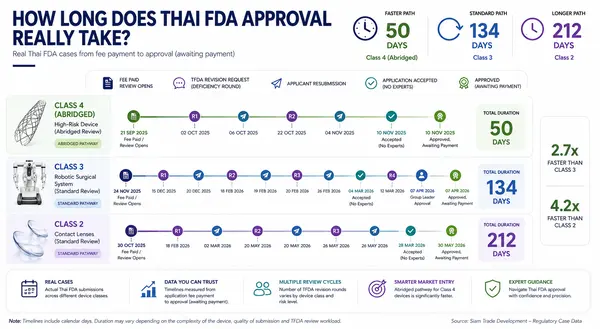
When these four conditions align — clean documentation, responsive client, smooth TFDA workflow, precise file management — registrations close quickly, even for high-risk devices. When they do not, the process expands accordingly.
Our role is to control what can be controlled, respond fast to what cannot, and give you an honest picture throughout. The timeline is elastic. The process is not mysterious. And the variable that matters most is the one you control before the application is ever submitted.
FAQ
How long does Thailand FDA medical device registration take? FDA Medical Device Registration Timeline depends on device class, documentation quality, and TFDA workflow. Based on real cases, timelines range from approximately 50 days for a well-prepared Class 4 abridged application to 7 months for a Class 2 device with documentation issues. TFDA’s internal deadline for standard applications is 200 days.
Does a higher device class mean a longer registration timeline in Thailand? Not necessarily. A Class 4 device with complete documentation can register faster than a Class 2 device with structural documentation problems. Device class affects the depth of review required, but documentation quality is the primary driver of how many revision rounds — and therefore how much time — a registration requires.
What causes delays in Thailand FDA medical device registration? The most common causes are incomplete or non-compliant documentation at submission, slow client response to TFDA revision requests, and TFDA internal escalation to senior officers. Some of these factors are manageable with preparation and experience; others are inherent to the regulatory process.